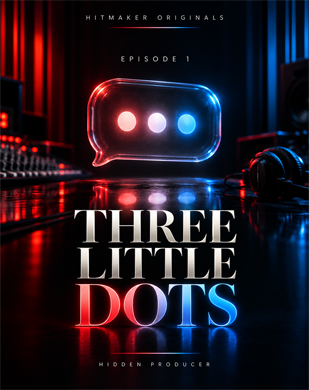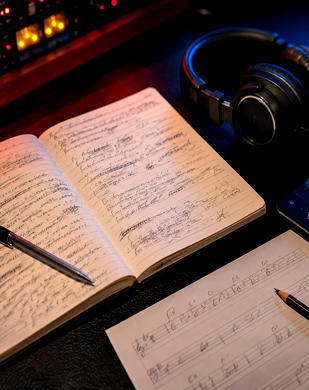

Hitmaker Originals begins with submitted lyrics—not a finished song, recorded demo, or existing composition. In every episode, the Hidden Producer sits down with one writer to uncover the story behind the words, understand what they intended to communicate, and identify exactly where the writing process became stuck. Our production vocalist performs selected sections exactly as submitted, allowing the writer and listener to hear the lyrics outside the page for the first time. We move through the song section by section, examining the verses, chorus, bridge, hook, transitions, repetition, pacing, and emotional direction. The strongest ideas are protected and amplified while anything confusing, overcrowded, misplaced, or incomplete is clearly identified. This is not criticism for the sake of criticism—it is a working session built to help the writer understand why certain choices connect and why others prevent the story from moving forward.
The episode ends with the completed lyric becoming a fully produced original song performed by one of our in-house production voices. The writer hears the finished record for the first time alongside the audience, completing the journey from an unfinished submission to a polished musical production.
A hit begins long before the chorus lands. It starts the moment a listener recognizes something of themselves inside the song. A feeling they’ve had. A place they’ve been. A thought they’ve never quite known how to say out loud. Great songwriting closes the distance between the person telling the story and the person hearing it. The details may belong to you, but the emotion has to belong to everyone. Make that connection and the listener stops hearing your song from the outside—they step inside it. Miss that connection, and even the perfect melody and production have a much harder job ahead.
The strongest lyrics can come from something deeply personal without ever trapping the listener inside someone else’s story. You share enough truth to make it real, but leave enough room for somebody hearing it to quietly replace your memories with their own. Your heartbreak becomes their heartbreak. Your summer becomes their summer. Your victory, regret, first kiss, last goodbye, or second chance suddenly belongs to them too. That’s when a song becomes personal without the listener even realizing how it happened. They aren’t simply relating to your story anymore—they’ve made the story theirs.
Now drive it home. The hook is the piece the listener carries away when the song is over—the melody, phrase, rhythm, or combination that keeps playing after everything else has stopped. Commercial music depends on that recall. A great hook arrives clearly, earns repetition, and returns often enough to become familiar without wearing out its welcome. Every chorus, musical turn, vocal choice, and repetition should strengthen it until the listener knows what’s coming and wants it anyway. That’s the payoff: when hearing it once isn’t enough, and hitting play again feels almost automatic.
 Story & Saturation
Talent matters. Being discovered requires somebody to actually encounter it.
There is no dignity in making great music that nobody ever gets the opportunity to hear. And yet that is exactly what happens to an enormous amount of great music, every single day, because the people who made it believed that quality alone was sufficient — that if the song was good enough, the world would find its way to the door. Sometimes that happens. Mostly it doesn't. The world is not standing outside your door listening for something remarkable. The world is distracted, overwhelmed, and navigating its own noise. So the music that gets heard is not always the best music. It is often the music that was pushed toward the ears of the people who needed to hear it, by someone who refused to wait for permission to be noticed.
That someone has to be you.
The crowd is real. So is your path through it.
The music business has always been crowded. Today it is crowded on a scale that previous generations of artists never faced and could not have imagined. A finished song can be uploaded in minutes, and on the day it goes up, it appears beside tens of thousands of other new releases — all competing for the same listeners, the same playlists, the same programmers, the same managers, publishers, labels, creators, music supervisors, and algorithms. The sheer volume of what exists makes invisibility the default. You do not begin with attention. You begin without it, and you build it, one encounter at a time, until the accumulation becomes undeniable.
So waiting quietly for someone to discover you is not a promotion strategy. It is a postponement of one. It is a way of protecting yourself from the discomfort of asking, by telling yourself that the right person will eventually stumble across your work on their own. They might. The odds are not in your favor. And the artists who build careers are almost never the ones who waited — they are the ones who understood that getting heard is itself a skill, separate from the skill of making music, and that both skills require cultivation.
Ask. Show up. Repeat.
Take the meeting. Send the email. Make the phone call. Introduce yourself after the show. Play the street corner. Enter the contest. Submit to the station. Send the demo. Make the video. Perform for twelve people. Perform for twelve thousand. Ask the local coffee shop if they'll let you play Friday night. Ask the creator with forty thousand followers if they'll use your chorus in a video. Ask the DJ to listen to one song. Ask the producer for criticism, even if what you really want is their enthusiasm — because real criticism from someone who knows the business is worth more than a polite compliment from someone who doesn't. Ask the assistant who actually controls the calendar how you can get five minutes. Learn their name. Remember it.
None of this is beneath you. None of it is a compromise of your artistic integrity. It is the work that exists beside the work, and the artists who pretend it doesn't exist are the artists who spend decades wondering why their talent never translated into an audience.
And sometimes, after you've done everything everyone else is doing, you do something nobody else thought to do.
Maybe everybody else sends an email, so you hand-deliver something that requires a human being to pick it up and look at it. Maybe you send twelve handwritten notes instead of twelve hundred automated messages, because twelve people who feel personally addressed will remember you longer than twelve hundred people who can see at a glance that they received the same message as everyone else. Maybe you perform your song on a sidewalk outside the venue where the people who would understand it are already gathering, because you figured out where your audience was before you asked them to come to you. Maybe you find the one unexpected angle — the local angle, the personal angle, the angle that makes your story specific enough to be interesting to someone who receives ten pitches a day — and you lead with that instead of leading with how good you think you are.
Not because gimmicks replace talent. They don't. A clever introduction to a mediocre song accomplishes nothing except getting the mediocre song heard slightly faster. But attention creates the opportunity for talent to be noticed. And in a world where the default is invisibility, creating that opportunity is not optional.
The difference between persistence and noise
There is an important difference between persistence and becoming a nuisance, and understanding that difference is part of the work.
Respect a "no." When someone passes, when someone doesn't respond, when someone tells you directly or indirectly that the timing isn't right or the fit isn't there, receive that information gracefully and move on to the next door. Respect people's time. A cold email that runs four paragraphs before getting to the point is not respecting someone's time. A pitch that requires someone to do research to understand what you're asking for is not respecting their time. Make it easy. Make it clear. Make it short enough that someone can read it in thirty seconds and know exactly what you want and why it might matter to them.
Don't spam. Don't deceive. Don't corner someone at a party and deliver a fifteen-minute monologue about your music when they came to have a conversation. Don't follow up so relentlessly that your name becomes associated with pressure rather than possibility. Don't manufacture relationships as a transaction — people can feel when they're being approached as a means to an end, and they remember it.
But don't confuse professional persistence with embarrassment, either. Following up once after a week of silence is not harassment. Introducing yourself to someone whose work you genuinely admire is not an imposition. Asking clearly for what you need, with respect and without apology, is not aggression. You are allowed to ask. You are allowed to introduce yourself. You are allowed to say, "I made something I think is worth three minutes of your time," and mean it, and say it without flinching. The ask is not the embarrassing part. The ask is the professional part. The embarrassing part would be spending years making music nobody ever hears because you were too uncomfortable to tell anyone it existed.
Build your people
Your friends should be sharing your music more often than you're sharing it yourself. That is not a statement about laziness. It is a statement about credibility.
When you share your own music, the person receiving it applies a discount. They understand that you believe in what you made. Of course you do — you made it. That belief is expected and it carries a limited amount of persuasive weight, because the person listening knows that every artist who ever lived believed in their own work, and some of them were right and most of them were not. But when someone who has no investment in your career, no relationship to benefit from, no ego tied up in the outcome — when that person says, "You need to hear this," the weight of that recommendation is entirely different. It arrives without the discount. It arrives as genuine testimony from someone who has nothing to gain, and that is exactly what makes it land.
So the work of building an audience is partly the work of building a community of people who genuinely believe in what you're doing. Not people you've recruited as a promotional team. Not people who feel obligated because you're friends. People who heard something real in your music and want other people to hear it too — because great music makes people want to share it. That impulse to share is one of the most reliable signals that something is working.
Give those people something worth talking about. Give them the song they can't stop playing. Give them the show that was unlike anything they expected. Give them the story of how the song was made, the detail that makes the music feel more personal and more theirs. Give them a reason to become part of the story rather than simply observers of it. When people feel connected to something, they evangelize for it in a way that no marketing strategy can replicate.
Let them become part of what you're building. Let them feel the ownership that comes from being early, from being the person who heard something before everyone else did, from being right about something that other people eventually caught up to. That feeling is powerful. It creates loyalty that outlasts the initial discovery. And it creates the kind of word-of-mouth that has launched more careers than any single industry contact.
Measuring the right things
Stop measuring every effort by whether it immediately produced a record deal, a publishing contract, or a number-one song.
That measuring stick will make almost every day feel like a failure, because most days in a career are not the day the deal happens. Most days are the days that make the deal possible. Most days are the accumulation. And if you spend those days feeling like failures because the outcome hasn't arrived yet, you will exhaust yourself before the accumulation reaches the tipping point.
One person heard you today who didn't know your name yesterday. That's movement.
One playlist added you to its rotation. That's movement.
One stranger followed your account after hearing thirty seconds of something. That's movement.
One producer answered your email, even if they said no. That's movement.
Twenty people came to a show and six of them came back the next time, and this time they brought someone with them. That's movement — and the someone they brought might be the most important person in the room.
Careers are built out of those small advances, stacking quietly on top of each other, until one of them — and you usually cannot predict which one — becomes a large advance. The person whose email you answered two years ago introduces you to someone. The playlist that reached five hundred listeners reaches someone who reaches someone. The show where you performed for twelve people is attended by one person who tells the right ten people the following week. You cannot engineer these moments. You can only make sure that when they happen, there is something real and finished and ready to be passed along.
Be ready when the door opens
When an opportunity does appear, be ready for it.
This sounds obvious. It is not always practiced. The moment arrives — the call, the introduction, the invitation to submit, the meeting that actually happens — and the artist who was not ready scrambles. They have a rough mix instead of a finished master. They have a photograph they hate. They have a biography that is either three words or three pages. They can't describe their music without launching into a defense of it, which is a different thing entirely. They don't know who owns the publishing on the song someone just asked them about. They have the music but they don't have the infrastructure around the music, and that infrastructure is what allows someone who becomes interested in you to take the next step without having to work for it.
Have the finished song. Have the clean master, mixed and mastered by someone who knows what they're doing, at the quality level that allows it to exist beside professional releases without asking for special consideration. Know who owns it — who wrote it, who owns the publishing, who controls the master — because questions about ownership surface at the exact moment things are moving forward, and not being able to answer them clearly is a way of slowing down the momentum before it builds. Have photographs that don't look like they were taken by accident in a parking lot. Have a short biography that tells someone who you are and what you make in the time it takes to read a paragraph, not the time it takes to read a Wikipedia entry. Have your contact information somewhere obvious on every platform, because people who want to reach you should not have to spend ten minutes finding out how. Know how to describe your music without delivering a ten-minute speech — because someone who can't describe their own work clearly makes the listener feel like understanding it is their problem rather than the artist's responsibility.
Make it ridiculously easy for someone who becomes interested in you to take the next step. Remove every unnecessary obstacle between their interest and their action. The music business is full of people who have limited time and unlimited options. Every extra step between their curiosity and your contact information is a place where you can lose them. Don't lose them to logistics.
Never stop making the thing
Most importantly, keep making music while you're promoting music.
This is where artists lose themselves in a way that is genuinely dangerous to a career. The promotion starts, the conversations start, the outreach starts, and the writing stops — because promotion feels urgent and visible in a way that sitting alone in a room writing songs does not. Promotion produces activity. Activity produces the feeling of progress. And in the absence of that feeling, going back to the page can feel like stepping backward when you should be stepping forward.
But promotion cannot become an excuse to stop developing the thing you're promoting. The thing you're promoting is the music. Without new music, the promotion has nothing to build toward. Without a growing catalog of work, the conversation you started yesterday has nowhere to go when it reconvenes six months from now. The artist who spent those six months writing has more to offer than the artist who spent them exclusively promoting what already exists.
Write another song. Then write a better one. Take what you learned from the last lyric and apply it to the next one. Take what you learned from performing and bring it back to the page. Take the criticism you received and let it cost you something useful. Play another room, even a small one, even one that doesn't feel like progress, because rooms teach you things about your songs that studios don't. Meet another person. Not because every person is a contact to be cultivated, but because songs come from experiences and experiences come from being in the world with other people. Send another submission. Try another approach when the last one didn't work. Stay curious about what might work better, because the method that doesn't produce results is information about what to try differently.
The doors that are yours to knock on
Take every legitimate step that could get you heard, seen, shared, remembered, or signed. Submit to every opportunity that fits. Reach out to every person whose work connects to yours. Play every venue that will have you. Post the music, the process, the story behind the song. Build the platform, slowly and honestly, one genuine connection at a time. Enter the contest. Submit to the station. Put the song in the room where the right ears might find it. Be the artist who showed up, the artist who asked, the artist who didn't wait for permission to believe that what they made was worth hearing.
You cannot control which door opens. You cannot control the timing, the taste of the person on the other side, the way the industry is moving on the day your music arrives, or the hundred external factors that determine whether a particular moment turns into an opportunity. That uncertainty is real and it is humbling, and sitting with it honestly is part of doing this work over a long period of time.
But you can control how many doors you knock on. You can control whether you knock loudly and clearly and professionally, or whether you knock once, quietly, and then step back and wait. You can control whether you are ready when the door opens, or whether you need more time to prepare the thing you should have prepared already. You can control whether the music keeps getting better, or whether it stops growing because you stopped pushing it.
And you can control whether the people who hear you today have reason to come back, and bring someone with them, and tell someone else, and pass the music along until it reaches the person who needed to hear it — which is, at the end of everything, what all of this is actually for.
Before you started reading this
The last time I tried to get my music heard, I:
The thing I avoided doing because it felt uncomfortable was:
The opportunity I didn't pursue because I wasn't ready was:
After you finish
The one action I will take this week that I have been putting off is:
The person I will reach out to is:
The thing I need to have ready before the next opportunity arrives is:
The music I need to finish so I have something worth promoting is:
The noise is real. Your voice is real. The distance between being lost in it and being heard above it is not only talent. It is everything you are willing to do, every single day, to make sure the music finds its way to the people it belongs to.
The most powerful moment in any career is not the one where everything finally falls into place. It is the moment you decide that you are going to make it as easy as possible for everything to fall into place — by showing up, by being ready, by refusing to disappear, and by continuing to make music that gives people a reason to pay attention.
That is how you are heard above the noise.
Not by being louder than everyone else.
By being impossible to ignore.
The lyric you're afraid to write may be the reason the song needs to exist.
Beginning songwriters do this constantly. Experienced songwriters do it too. It doesn't matter how long you've been writing or how many songs you've finished or how many times you've sat in a room with other writers who told you that vulnerability is the whole point. The moment still comes. You get close to the real subject — and you retreat. Something inside you pulls back from the edge at exactly the moment the edge is where the song needs to go, and you find a softer version, a safer image, a vaguer feeling, a way of communicating the general direction of the truth without actually arriving at it.
And the song becomes something lesser than it was trying to be.
That retreat happens so fast, and feels so natural, that most writers don't even notice it occurring. They don't experience it as a retreat. They experience it as a choice — a craft decision, an editorial judgment, a sense that a different line serves the song better. And sometimes that's true. But sometimes it is not a craft decision at all. Sometimes it is fear dressed up as craft, and the difference between the two is one of the most important distinctions a songwriter can learn to make.
What holding looks like
There is a line sitting somewhere in your head that says exactly what happened. It is specific. It is uncomfortable. Maybe it is embarrassing in a way that makes your face feel hot just thinking about it. Maybe it admits that you were wrong, not in a noble or redemptive way, but in a small and human and unflattering way. Maybe it says what somebody did to you, in language that makes clear how much it actually hurt rather than in language that makes you sound like you handled it with grace. Maybe it exposes jealousy — the kind you're not proud of, the kind that arrived uninvited and stayed too long. Maybe it exposes grief that still has teeth. Maybe it exposes desire, or resentment, or loneliness that you've been performing your way through. Maybe it exposes addiction, or failure, or anger that scared you when it arrived, or love that felt like too much to admit out loud, or regret for something you cannot undo and have been carrying in the dark ever since.
You know the line.
You knew it before you sat down to write. In some cases you've known it for years. It is the sentence at the bottom of the whole experience, the one that, if you said it out loud in a room full of people, would change the temperature. It is the true thing.
And you replace it with something safer.
You find the line that gestures toward that true thing without committing to it. You find the image that suggests the feeling without claiming it. You find the rhyme that fills the space the real line was supposed to occupy, and you build the song around that substitution, and then you wonder why it doesn't land the way you hoped — why it feels slightly airless, slightly distant, slightly like you're describing something that happened to someone else rather than something that happened to you.
That's holding the hit hostage. You have written the song around the song without ever writing the song.
Where the wall comes from
The wall usually goes up because the writer starts imagining the audience before finishing the confession. This is the mechanism, and it is worth understanding clearly, because once you see it you can catch it happening in real time.
You are writing. You reach a moment of genuine feeling — a line, an image, a sentence that arrived from somewhere deeper than the usual writing process, the kind that makes you pause because it feels more true than anything else on the page. And in that pause, instead of following it, you look up. You look outward. You start imagining the room the song will eventually be in, the ears it will reach, the faces of specific people reacting to what you just wrote.
What will my family think when they hear this? Will they know who this is about? Will the person this is about know it's about them, and will that cause a problem, or an argument, or a silence that lasts for years? What will my friends think — will they see me differently? Will they think I'm weak, or damaged, or bitter, or still stuck in something I should have moved on from? What if somebody thinks I'm angrier than I appear? What if they think all of this actually happened exactly as I've described it?
And then the most dangerous question of all, the one underneath all the others:
What if I tell them who I really am?
That question is where most held hits live. Not in the fear of judgment about a specific lyric. In the deeper fear of being known — actually known, past the performance, past the image, past the careful version of yourself that you've curated for public consumption. The fear that if you write the true thing, you will have handed someone the map to the inside of you, and you don't know yet whether the inside of you is something they will accept or something they will use against you.
That fear is human. It makes complete sense. And it will cost you the best work of your career if you let it make your decisions.
What the fear doesn't know
Here is what the fear doesn't know, or pretends not to know: the people who hear a song are not listening for evidence to judge you with. They are listening for themselves.
Every person who has ever been moved by a song was moved not because the song was about the artist's specific life, but because something in the specific life of the artist rhymed with something in their own. They heard a detail that matched a feeling they had never been able to name. They heard an admission that matched a secret they had been carrying. They heard the true version of something they had only ever heard the safe version of, and the truth of it — the specificity of it, the particularity of it — was exactly what allowed them to recognize themselves inside it.
This is the paradox that every songwriter has to internalize before they can do their best work: the more specific and personal and uncomfortably true you make a song, the more universal it becomes. Not despite the specificity. Because of it. "I miss you" tells the listener what category they are in. Reaching across the bed at four in the morning and finding the other half still cold and still empty and still yours tells the listener exactly where they have been. The listener supplies the rest — their own four in the morning, their own side of the bed, their own version of the loss — and the song becomes theirs in a way that no general statement about missing someone ever could.
The general statement is about your experience. The specific detail is about the human experience, filtered through yours. And the human experience is what a listener came to find.
This is not an argument for confessional writing as the only mode. There are many ways to arrive at emotional truth, and autobiography is one path among several. Fiction can carry truth. Metaphor can carry truth. A character who is nothing like you can speak from a place that is entirely you. The lesson is not that you must write about your own life in your own words with your own name attached to it. The lesson is simpler and harder than that.
Stop lying to the song because you're frightened of the truth underneath it.
The songs you already know
Think about the songs that changed something in you. Not the ones you admire technically. The ones that stopped you. The ones you heard for the first time and felt something shift — felt something loosen, or crack open, or finally get said that had been waiting to be said. The ones you played on repeat not because the production was interesting but because you needed to be inside them a little longer, needed to stay in the feeling they had excavated.
Now ask yourself what those songs have in common.
Not production style. Not genre. Not tempo or key or instrumentation. What they have in common, almost without exception, is that the person who wrote them went somewhere most people don't go. They said the thing most people soften. They admitted the thing most people protect. They named the feeling that most people gesture toward and then retreat from, and they named it with enough specificity that you knew they had actually been there — that this was not a performance of emotion but the record of it.
Those songs feel the way they feel because someone paid a price to write them. Not necessarily a dramatic price, not necessarily a public confession, but the private price of being honest on the page when dishonesty would have been easier and safer and more comfortable. They went into the room where the real thing was and they came back with it, and then they shaped it into something that could travel — into the ears of strangers, across decades, into moments the songwriter never anticipated and could not have designed.
That is what you are capable of making. And the only thing standing between you and making it is the wall that goes up when you get close to the real thing.
The exercise: write the thing you won't write
When you reach a lyric that makes you uncomfortable, don't automatically delete it. Don't smooth it over. Don't reach for the safer version before you've stayed with the uncomfortable one long enough to understand what it's doing there. Put a box around it. Mark it. Sit with it for a moment longer than feels comfortable, and ask why it bothers you.
Then write ten more lines about the thing you are trying not to say. Not ten lines for the song. Ten lines for you. Nobody has to hear them. Nobody has to see them. This is an exercise between you and the page, and the page will not judge you, and the page will not tell anyone, and the page will not change how people see you or treat you or remember you.
Write the cruel version. Write the version where you are not the hero. Write the version where you were wrong and you knew you were wrong and you did it anyway. Write the embarrassing version — the one where the thing you wanted was smaller than you'd like to admit, or more ordinary, or more desperate. Write the selfish version, the one where the motivation was not noble. Write what actually happened at two in the morning instead of writing that you were lonely — write what lonely looked like on that specific night, in that specific room, with that specific absence pressing against everything. Write what was sitting untouched on the kitchen table instead of saying the relationship fell apart — write what the object was, what it meant, who had last touched it, why you couldn't move it. Write the sentence you wish you'd said before the door closed and didn't, and then write the sentence you actually said instead, and then write what the difference between those two sentences cost you.
Now you have material.
Not all of it belongs in the song. Most of it doesn't. The exercise is not the song. But somewhere inside those ten lines is the thing the song has been trying to reach, the sentence that arrived when you stopped protecting yourself long enough to let it through. And that sentence — or the feeling it carries, or the image it contains, or the specific detail it leads you to — is the difference between the song you were writing and the song you needed to write.
Becoming the editor
Now you become the editor. Not the frightened writer who retreats from the real thing, and not the raw confessor who hands the listener every private fact without consideration. The editor. The craftsperson who knows the difference between what is true and what is necessary, between what happened and what belongs in the song.
You don't necessarily release the diary. You extract the truth from it.
There is an enormous difference between those two things, and understanding it is what allows you to be genuinely honest in your writing without requiring you to sacrifice every boundary and every privacy. The diary contains everything — the petty details, the unflattering motivations, the confusion and contradiction and mess of actual experience. The song contains the emotional truth of the experience, shaped and compressed and made into something that can travel. The diary is for you. The song is for everyone.
So you go into the diary — the ten lines you wrote, the uncomfortable admissions, the things you marked in boxes because they scared you — and you ask: what is the true thing underneath all of this? Not the most dramatic detail. Not the most shocking admission. The truest thing. The feeling or image or specific moment that carries the largest amount of what the experience actually was. That is what goes in the song. Not because you are sanitizing the truth, but because you are finding its essence rather than its entire surface area.
A listener may never have lived your exact experience. They don't need to. They are not coming to the song as biographers looking to reconstruct your life. They are coming as human beings who have had experiences of their own, and they need enough of your truth to recognize their own truth inside it. Give them the entry point. Give them the specific detail that opens the door. Trust them to walk through it and find what they're looking for on the other side.
That is the craft. And it is a craft that requires both the courage to go to the real place and the skill to bring back only what is needed — which is a harder combination than either one alone.
The ones who went there
Every artist whose work has lasted, whose songs are still playing in living rooms and cars and headphones long after the moment they were written, went somewhere in the writing that required something from them. That is not a romantic idea about suffering producing art. It is a simple observation about what it takes to create something that another person can genuinely enter.
The songs that last are the ones where the writer didn't stop at the edge. They're the songs where someone sat with the uncomfortable line long enough to understand it, and then shaped it into something that didn't need to announce its own bravery because the bravery was already inside the work. You can hear it. Not as a performance of rawness. As the real thing. And listeners know the difference, even when they can't articulate it, even when they couldn't tell you exactly what makes one song feel true and another feel constructed. They know. They have always known.
The songs where the writer held back — where the real line was replaced with the comfortable one, where the specific image was traded for the general feeling, where the confession was edited into something that could not cause any discomfort to anyone — those songs are usually fine. Sometimes they're even good. But they're rarely the ones that stop someone in the middle of whatever they were doing and make them feel suddenly, unexpectedly understood.
That feeling — the feeling of being understood by someone who has never met you, through words that were written in a room you've never been in, about an experience that is not yours but somehow completely yours — is the thing that songwriting is capable of at its best. And you cannot manufacture it by being careful. You can only create it by being honest.
What happens when you let it go
There is a particular kind of freedom that arrives after you write the thing you were afraid to write. Not immediately — immediately there is often a residual fear, a moment of exposure, a sense of having gone further than you meant to. But underneath that, and often arriving quickly behind it, is something else: relief. The specific relief of having finally said a true thing, of having put language around something that has been sitting in the dark without language, of having met it directly instead of talking around it.
And then something else happens, which is that the song changes. It changes in a way that is hard to describe but easy to feel. The song that was slightly distant, slightly constructed, slightly like a description of something rather than the thing itself — that song becomes something you can actually stand inside. The lyric that you were performing becomes a lyric you inhabit. And the listener, when they hear it, steps inside it too, and finds themselves there, and feels the thing you were trying to protect yourself from feeling in public, and is grateful — genuinely, sometimes overwhelmingly grateful — that you didn't protect yourself.
Because they needed someone to say it first. They needed someone to name the thing they had been carrying. They needed to hear the embarrassing version, the uncomfortable version, the version that doesn't make anyone look entirely good or entirely certain or entirely okay — because that's the version they recognize. That is the version of experience they actually live in. And they have been waiting, without knowing it, for someone to write a song that lives there too.
That song can be yours. The held hit can be released. The thing you thought was too much, too specific, too embarrassing, too small, too dark, too honest, too real — that thing is frequently the exact thing the song needed.
Before you started reading this
The line I have been avoiding in my current song is:
The reason I've been avoiding it is:
The thing I am most afraid people will think if I write it is:
After you finish
The ten lines I will write about the thing I've been avoiding are:
The true thing inside those ten lines is:
The version of this that belongs in the song — specific, honest, shaped but not sanitized — is:
So when you're writing and something arrives on the page and your first instinct is I can't say that — don't immediately erase it.
Stay there for another minute.
Ask what it's doing there. Ask what it knows that the rest of the song doesn't. Ask what the song becomes if you follow it instead of replacing it. Ask whether the discomfort you feel is the discomfort of poor craft or the discomfort of genuine honesty, because those are very different discomforts and they require very different responses.
The frightened line is not always the right line. Sometimes it belongs in the ten pages and not the lyric. Sometimes the craft decision really is a craft decision and the safer image truly does serve the song better. Your judgment is part of the work.
But sometimes — more often than most writers allow — the frightened line is the truest line on the page. And the song has been waiting for you to have the courage to keep it.
You don't have to perform the bravery.
You just have to stop performing the safety.
Write the line. Shape it into something that can travel. Hand it to a stranger and trust that they will know what to do with it.
Because the most powerful thing you can say in a song is the thing you were most afraid to say.
And the listener on the other side of it has been waiting their entire life to hear that they are not alone in it.
That is the held hit. And it has always been yours to release.





 Insider Info
Know what you created. Know what you own. Know what you're agreeing to before you give any part of it away.
Music rights can become complicated quickly because what listeners experience as "one song" can actually involve several different rights, several different contributors and several different streams of money.
If you're beginning to release music, start with one fundamental distinction:
The song and the recording of the song are not necessarily the same property.
The underlying composition consists of the music and lyrics. The finished recorded performance—the actual audio file people stream, download, broadcast or press—is generally referred to as the master or sound recording.
Those rights can have different owners.
A lyricist may write the words. A composer may write the music. Several people may write together. A producer may or may not receive a writing interest depending upon what that person actually contributed and what everyone agreed to. Performers can have rights or compensation associated with their performances without necessarily owning the underlying composition. The master may belong to the artist, a production company, a label, multiple parties, or another owner depending upon the agreements involved.
That is why the sentence "I wrote the song" does not answer every ownership question.
Splits should be discussed before success makes the conversation difficult.
If two or more people create a composition together, establish the songwriting split while everybody still remembers what happened and everybody is still speaking to one another.
Write it down.
Who wrote the lyrics?
Who contributed to the composition?
What percentage does each writer own?
Who controls or administers those interests?
Is there a publisher involved?
Who owns the master?
Did a producer receive a fee, royalty, ownership interest, writing percentage—or some combination?
Do not rely on "we'll figure it out if something happens."
Something happening is precisely when an informal understanding can become a serious dispute.
A simple split sheet created at the time of writing can prevent an extraordinary amount of confusion later.
Understand the difference between permission and ownership.
A license generally gives someone permission to use specified rights under specified conditions while ownership remains elsewhere.
An assignment transfers ownership of the rights identified in the agreement.
Those are materially different transactions.
Before signing an assignment, read exactly what is being assigned. Is it the composition? The master? Both? A percentage? Particular exploitation rights? Is the transfer permanent or limited? Does it cover one territory or the world? Can the rights be transferred again? Is there a reversion provision? What compensation is being exchanged? Are future royalties retained, shared or surrendered?
Never substitute what somebody verbally told you for what the agreement actually says.
How the Hitmaker model works
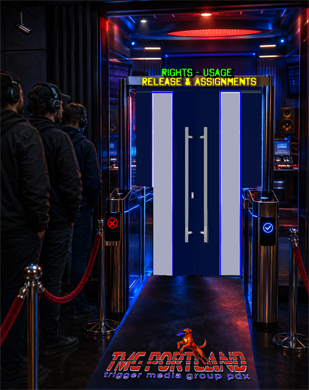
Hitmaker submissions involving a prize, payment, digital delivery, pressed vinyl or other stated consideration operate under the rights-and-assignment terms presented with that particular submission or promotion.
Where the applicable Hitmaker agreement requires rights to be surrendered or assigned in exchange for the stated payment or prize, that assignment is part of the transaction—not fine print that should be ignored.
Read it before agreeing.
The exact agreement controls what is transferred, what is retained, what consideration is provided and whether any continuing participation or royalty exists. Do not assume that a payment, vinyl pressing, prize or other consideration automatically leaves additional rights or royalties in place unless the governing terms specifically say that it does.
If you do not understand what you are transferring, do not click through simply because you want to enter.
Ask.
And for any agreement involving rights that may become valuable, consider having a qualified music or entertainment attorney review it before you sign.
Before releasing anything, build good habits.
Keep your original drafts and dated project files. Keep session files. Keep emails and messages documenting collaborations. Record the legal names and contact information of everyone involved. Complete split sheets. Keep copies of producer and musician agreements. Know who owns the master before paying to distribute it.
Register and administer the rights that apply to your work through the appropriate organizations and systems for your situation. Make sure identifying information and metadata are accurate. Keep your ISRC information for recordings where applicable. Keep track of releases, versions, remixes and alternate masters instead of treating the final WAV file as the entire business record.
If you use beats, samples, loops, outside musicians, purchased tracks or third-party material, understand the permission attached to them before release, not after somebody notices the song.
"Royalty free" does not necessarily mean "do anything you want with it."
A beat lease is not necessarily ownership.
Paying somebody to perform does not automatically resolve every possible ownership question.
Downloading something from the internet does not make it yours.
And giving someone your recording does not necessarily give them ownership of the composition underneath it.
The professional habit is simple:
Know what came from whom. Put agreements in writing. Keep the records. Read before signing.
You worked too hard to create the music to become careless when the paperwork finally matters.
This guide provides general educational information, not legal advice. Rights can vary by agreement, jurisdiction and circumstances.
There is a moment that happens to almost everyone who writes. You have the idea. You know what you want to write about. Maybe the words come quickly, maybe they fight you for three days, but eventually there they are: verses, a chorus, a title, a story. You read it back and think, This is pretty good.
And maybe it is. Maybe it is memorable. Maybe there is a phrase you can already imagine people repeating. Maybe the story makes sense from beginning to end. Maybe you are proud of it.
So we are not going to tell you that you wrote it wrong.
We are going to ask a much more interesting question: Have you actually discovered what you wrote yet?
That sounds ridiculous. You wrote it. Of course you know what it says. But knowing what your words say and knowing what they mean are not always the same thing. That difference is where we are going. And before we're finished, you may discover that the song you thought you were writing isn't the song you were writing at all.
THE QUESTION THAT CHANGES EVERYTHING: What am I not saying that I am actually trying to say?
Meet Alex
We're going to invent a songwriter named Alex. Alex could be anybody. Alex has been writing for a while and doesn't need somebody explaining what a verse is. Alex knows songs. Alex listens carefully, notices hooks, writes regularly, and has probably imagined what it would feel like to hear somebody else singing something they wrote.
One night, Alex writes this:
Your coffee cup is by the sink
Your picture's hanging in the hall
I tell myself I never think
About you anymore at all
But every night when the daylight ends
I wonder where you've been
I'd give anything to have you here
And hold you once again
Nothing is catastrophically wrong with it. We understand what happened. Someone is gone. Alex misses that person. There are recognizable images. There is rhyme. There is a clear emotional statement. You could continue developing this lyric exactly as it is. But first, we're going to ruin Alex's evening. We're going to ask why.
Not, Why did the person leave? Why does Alex need to write about it? Those are very different questions.
Alex's first answer might be obvious: Because I miss them. Fine. Why? Because they were important to me. Fine. Why? Because I loved them. Still fine. But none of those answers has uncovered anything that wasn't already sitting on the surface. We could have guessed all three from the lyric. The lyric already told us. The work of discovery is to go somewhere the lyric hasn't been yet — to find the room that exists behind the door you've already walked through. The answers we're looking for are not the ones that confirm what we've written. They're the ones that complicate it. They're the ones that make us slightly uncomfortable, or that arrive with a kind of weight we weren't expecting, or that feel more true than the polished version we worked so hard to put together.
So we keep going.
What exactly do you miss? Maybe Alex answers: Having them around. Still broad. What does "having them around" actually mean, in the specific texture of a Tuesday afternoon, in the particular silence of a kitchen at seven in the morning? Now Alex has to think. And the longer Alex sits with that question instead of reaching for the easiest answer, the closer we get to something worth writing down.
Maybe the answer becomes: I miss having somebody who knew what I was going to say before I finished saying it.
There.
Did you feel the door move?
We aren't necessarily through it yet, but something just happened. "I miss you" could belong to millions of people. In fact, it belongs to everyone who has ever lost anyone. It is so universal that it barely means anything anymore, the way the word "love" can stop meaning anything if you say it too many times in a row. "I miss having somebody who knew what I was going to say before I finished saying it" belongs to a person. It belongs to an experience. It belongs to a specific kind of intimacy that takes years to build and that, once it disappears, leaves behind a very particular silence — the silence of finishing your own sentences again, of having to explain yourself again, of suddenly being opaque to the world. Now we have somewhere to go.
Don't Write Yet
This is the difficult part. Once writers find something interesting, the instinct is often to immediately turn it into a lyric. The discovery feels fragile, and the impulse to capture it makes sense. But resist that for a moment. We're still discovering. Turning it into a lyric too quickly can actually close the door we just opened, because we start making it fit the structure we already have rather than letting the structure grow around what we've found.
Suppose we ask Alex another question: What is the hardest part of this person's absence that you would never admit to them?
Alex thinks. I don't know. That's an answer. Not every question opens a door. Some questions lead directly into a wall. That's fine. Walk around it. Try another. What changed about you when this person left? I had to learn to be alone. Still broad. What does being alone look like, not as a concept but as a daily experience? The house is quiet. Expected. What does the quiet make you do?
Now Alex gets uncomfortable.
Sometimes I still start talking to them before I remember they're not there.
Stop.
There it is. Not because that sentence is necessarily going into the finished lyric. It may never appear anywhere. But Alex has just uncovered something the original lyric never told us. This isn't simply a person standing in a house missing somebody. This is a person whose life still instinctively makes room for someone who is gone. Whose muscle memory, whose daily habits, whose reflexes have not yet learned the new shape of things. That's different. And it's more specific than anything in the original draft.
Notice what we did not do. We didn't search for a better rhyme. We didn't replace "hall" with a more impressive word. We didn't tell Alex to become poetic. We asked Alex to become specific enough to encounter the truth.
Your Turn
Take the lyric you're working on. Don't change anything yet. Write one sentence answering: What do I think this is about? Now answer: Why does that matter to me? Then ask it again. Why does that matter to me? Keep going until your answer surprises you, makes you uncomfortable, becomes unusually specific, or suddenly sounds more honest than the answer you started with. The point is not to arrive at a destination you've already been to. The point is to keep moving until you reach somewhere new.
If nothing happens, that's okay. Change the question. Try: What am I not saying? Or: What would be hardest to admit? Or: What happened that made me need to write this down? You are not hunting for the "correct" answer. There isn't one. You are looking for the answer you didn't have when you started — the one that feels like it came from somewhere slightly further inside than the last one.
Some writers find that they need to move around while they do this. Some need silence. Some need to write the questions on paper instead of holding them in their heads. Some need to answer out loud. None of that matters. What matters is that you're not letting yourself get away with the first answer every time, because the first answer is almost always the most familiar one, and the most familiar answer is rarely the most true.
The First Draft Is Evidence
Now let's return to Alex's original lyric. Something interesting happens when we read it again. The words haven't changed, but our understanding has.
Look at the first line: Your coffee cup is by the sink. Originally, that was scenery. It was set-dressing, a way of establishing that someone used to live in this space. Now it might be evidence. Why is the cup still there? Alex could have washed it. Could have packed it away. Could have thrown it out. Could have put it in a cabinet like all the other cups. Why hasn't Alex? We ask. Alex answers: Because it was the last cup they used before they left.
Now the cup has a history. Why keep it by the sink? I don't know. Ask again. Sit with not knowing for a second. Then: Maybe because putting it away would mean admitting they're not coming back.
There.
The coffee cup just became more important than I miss you. Not because coffee cups are profound. Because this particular coffee cup now carries behavior, denial, memory, and hope. It is doing emotional work that an abstract statement can never do. Alex doesn't need to tell us: I cannot accept that you are gone. Alex can show us a cup nobody is allowed to move, sitting in exactly the same spot it has always been in, in a house that has otherwise changed. The reader understands. And understanding it themselves, arriving at the conclusion through their own perception rather than having it handed to them in a label, makes the feeling land differently. It lands the way real grief lands — quietly, through ordinary objects, without announcement.
That's what depth can do. It takes an ordinary object and gives it emotional responsibility.
The Same Object, Three Levels
The object: A coffee cup.
What it is: Something the person used.
What it remembers: The last ordinary morning before the relationship ended.
What it reveals: Alex hasn't put it away because some part of Alex has not accepted the ending.
The object didn't change. Our understanding did.
And now Alex has choices. That is important. This class is not going to "fix" Alex's lyric and tell you that our version is the right version. Discovery creates choices. Alex might keep the cup as a central image. Alex might remove it entirely and use what it revealed to inform something else. Alex might mention it once and never return to it. Alex might let it become the organizing image of the entire piece. The cup's actual presence in the finished lyric matters far less than what it told Alex about the experience underneath the lyric. The craft begins after the discovery. But without discovery, those choices are mostly decoration — surface variation on a surface understanding.
What Else Have You Accidentally Written?
Go through your own lyric and circle the nouns. Not the emotions. The things. A doorway. A jacket. A receipt. A highway. A glass. A telephone. A suitcase. A photograph. A dent in a car door. A grocery list. A pair of shoes. A motel key. A Christmas ornament. A half-empty bottle of shampoo. Whatever is actually there. Things you chose, consciously or not, when you sat down to write.
Pick one. Then interrogate it. Why did your brain choose that object? What happened around it? Who touched it? Why is it still there, or why isn't it? What would happen if it disappeared? Does it mean something different now than it did when the story began? Would another person look at it and see nothing while your narrator sees everything?
You may discover there is absolutely nothing there. Good. Move to the next object. You aren't trying to force symbolism onto everything in the room. A spoon is allowed to remain a spoon. Not every object is carrying a hidden world. But occasionally you'll find the coffee cup. And when you do, you'll know, because the answer to the question Why is it still there? will make you stop and look at the whole lyric differently. That change of perspective — that moment when you realize the room your narrator is standing in contains more than you knew — is worth everything you've done to get there.
Now We Perform Surgery
Alex began with:
Your coffee cup is by the sink
Your picture's hanging in the hall
I tell myself I never think
About you anymore at all
Let's separate what those lines are doing. The coffee cup gives us an object. The picture gives us another object. Then Alex tells us directly that the narrator pretends not to think about the person. But we have now discovered something better than the explanation. Alex still talks to this person accidentally. Alex has preserved the last cup they used. Alex is behaving as though absence might somehow be temporary. So let's imagine Alex goes back to the page. Not to make it "prettier." To make it more honest.
Maybe Alex writes:
Your coffee cup is by the sink
I haven't moved it since that day
This morning I said, "We're out of milk"
Then remembered you went away
Is that the final version? Who cares? That's not the lesson. Look at what changed. The original told us: I think about you. The new version lets us catch the narrator forgetting, for one ordinary second, that the person is gone. The reader gets to experience the absence instead of receiving a report about it. We don't observe the grief from outside. We are standing in the kitchen with Alex when it happens, in real time, in the middle of a completely ordinary thought about milk. That specificity — the ordinariness of it, the smallness of the trigger — is what makes it feel true rather than performed.
That's the surgery. We didn't decorate the original thought. We didn't find fancier language for the same idea. We found the living thing underneath it and we let it breathe.
Don't ask: "How can I make this line more poetic?" Ask: "What is this line protecting me from saying?"
Sometimes the Line You're Most Proud of Is the Problem
This part hurts. Every writer eventually produces a line they love because it sounds like a lyric. You know the kind. It has balance. Maybe an unexpected word. Maybe a beautiful image. You can practically see it printed over somebody's moody photograph. You know, the moment you write it, that it's going on the demo, that it's going in the chorus, that it is the center of everything. And sometimes it has absolutely nothing to do with the emotional truth of the piece.
So try something slightly cruel. Find your favorite line. Now temporarily remove it. Don't delete it — we're not monsters. Put it somewhere safe, in a separate document or at the bottom of the page. Then ask what the lyric loses without it. Does the story become unclear? Does an important emotion disappear? Does the narrator lose character? Does a later idea stop making sense? Does something structural collapse?
Or do you mostly miss the line because it sounded impressive?
Those are different losses. A beautiful line can absolutely earn its place because it is beautiful. Language is allowed to be pleasurable. There are lines in songs that survive for decades because of the way they sound, the way they move through the mouth, the way they sit in a melody. That is not nothing. But you should know why you're keeping the line. You should be able to make the argument for it. Your lyric should not have to carry a sentence simply because you are proud of having written it, because that sentence is collecting rent it hasn't earned, and somewhere behind it is a truth that never got to speak.
What Is Your Narrator Hiding?
By now, Alex understands that the song isn't merely about missing someone. It's about the strange period after loss when your habits haven't caught up with reality. When your body still lives in a version of your life that no longer exists. That gives Alex another question: What is the narrator pretending?
The original lyric already gave us a clue: I tell myself I never think / About you anymore at all. There is a contradiction. The narrator claims not to think about someone while writing an entire song about thinking about them. That's useful. Contradictions are always useful. Characters who contradict themselves are characters who feel real, because real people contradict themselves constantly, insisting they're fine while their behavior tells a completely different story.
Maybe the narrator is performing strength. Maybe they tell friends they're fine, that they're doing great, that the relationship ending was probably the right thing. Maybe they've packed everything away except that cup. Maybe they've deleted the phone number but know it by heart. Maybe they've started dating again and hate themselves for comparing everyone to the person who left. Maybe they have a speech they give at parties about how they're really happy now, and they've given it so many times they almost believe it. We don't need all of those. In fact, using all of them would probably destroy the lyric, because you'd be shoving every possibility into a space that only has room for a few. We're creating a field of possibilities, not a list of things to include. Discovery is about knowing what's available, so that the choices you make are deliberate rather than accidental.
This is another place writers sometimes rush. They discover one true thing and immediately shove every consequence of it into the song. You don't have to. Depth isn't the quantity of emotional information. It's the weight carried by the information you choose. A single image, fully understood, can carry more than five images that were placed there because they seemed thematically appropriate.
Give the Reader Something to Discover
There is a special kind of satisfaction in understanding something a fraction of a second before somebody explains it. Readers and listeners feel it constantly — that little click of recognition, that private sense of I see what's happening here that arrives just before the lyric confirms it. That experience is pleasurable. And lyrics can give a listener that pleasure deliberately, by trusting them.
Imagine Alex writes:
I finally boxed your things last week
The books, the shirts, that photograph
But one cup's drying by the sink
Like you're still coming back
We understand the contradiction. Alex is trying to move forward while preserving one tiny piece of the old life. The behavior tells us everything about what Alex is actually experiencing, regardless of what Alex is telling everyone else. But perhaps the last line explains too much. Like you're still coming back tells us the meaning of what we just saw. It wraps it up. It closes the door right after opening it. What if Alex doesn't tell us why the cup remains? What if the lyric trusts us enough to end with the cup drying by the sink and say nothing else? The image would carry the weight by itself, and the listener would arrive at like you're still coming back on their own — which means they'd arrive at it inside their own chest, not just inside their ears.
That is another form of depth: knowing when you have already communicated enough. When your reader has reached the conclusion, continuing to explain it can actually make the moment smaller. The explanation takes up the exact amount of space the feeling was supposed to occupy.
So during your rewrite, look for places where you say the same emotional fact twice: once through evidence and again through explanation. Once through behavior and again through labeling it. Try removing the explanation. Read what's left. Did the meaning disappear? Or did the reader suddenly get room to feel it?
The Question Under the Question
Now we're going deeper.
Alex has discovered the behavior. Alex has discovered the object. Alex has discovered the contradiction, the denial, the gap between what the narrator says and what the narrator does. But we can still ask: Why does this matter so much? Not as a prompt for another piece of imagery, but as a real question about the stakes of what we're writing.
Maybe Alex finally answers: Because if I accept that they're really gone, I have to accept that the person I was with them is gone too. That's not where we started. Remember? We started at: I miss them. Now we are somewhere else entirely. The loss is no longer only about another person. It is also about identity. It is about the particular version of yourself that only existed inside a specific relationship — the person you were when you were at your easiest, or your most honest, or your most alive. That person doesn't live anywhere else. They only existed in relation to someone who is gone.
Who am I after the person who knew me best no longer knows my life?
Now reread: This morning I said, "We're out of milk" / Then remembered you went away. It means more. Not because the words became complicated. Because the understanding underneath them did. The narrator isn't just missing a person. The narrator is living inside a life that was built for two people and hasn't figured out yet how to become a life for one. Every habit is evidence of something that no longer exists. Every ordinary moment is an ambush.
That is an important distinction: depth does not require vocabulary nobody uses in conversation. It doesn't require turning every line into a metaphor. It doesn't require sounding tortured, literary, or profound. It doesn't require anything you don't already have access to. Sometimes the deepest sentence in the entire lyric is the simplest one — because the writer finally understands what the sentence is carrying. The weight is invisible. It comes from the understanding, not from the words themselves.
Stop Here
Don't read the next section yet.
Go back to the sentence you wrote earlier: I think this is about… Read it. Now, without looking at that answer, finish this sentence: I think this might actually be about… Compare them. Are they identical? They might be. There is no prize for manufacturing a revelation. Some songs really do begin exactly where they end up, and the work is execution rather than excavation.
But if they are different, don't rush past that difference. Look at what changed. What question caused it? What detail caused it? What did you notice? What did you admit? That difference is yours. It belongs to the specific song you're writing and the specific experience underneath it. Nobody else found it the same way.
Now Let the Discovery Change the Writing
This is where all of this earns its place. Self-discovery without action can become an interesting afternoon. We're here to write.
Take one section of your lyric. Not the entire thing. Read it slowly. For every line, ask: Is this telling me something I now know how to show? Suppose you wrote: I was lonely every night. What does lonely do, specifically, in your specific experience of it? Does lonely sleep with the television on because silence has become unbearable? Does lonely cook enough food for two out of habit, then stand at the counter eating half of it and throwing the rest away? Does lonely stop going to a restaurant because the host still asks, "Just one tonight?" — and the way they say it, with that small adjustment in their voice, is somehow the worst thing that happens all week? Does lonely keep checking a phone that hasn't rung? Does lonely discover that nobody else knows the password to the Wi-Fi because the other person always handled it, and that small administrative fact somehow feels like the loneliest thing of all?
Those aren't replacements for your line. They're questions about your experience. Your version of loneliness may look nothing like any of those. Find yours. That's the point. "Lonely" is the category. Your detail is the life. The category tells us what drawer to open. The detail tells us everything inside it.
Find the Sentence You Would Never Put in the Song
Here's an exercise that may produce nothing. It may also produce the entire song.
Open a blank page. At the top, write: THE SENTENCE I WOULD NEVER PUT IN THIS SONG IS: Then finish it. Don't rhyme it. Don't make it beautiful. Don't make it appropriate. Nobody has to see it. You can delete it afterward. Let it be petty. Let it be embarrassing. Let it be selfish. Let it be loving. Let it be furious. Let it be something you don't completely understand, something that surprises you the moment you write it down.
Maybe it's: I don't actually want you back; I want to be the person I was before you left. Maybe it's: I'm angry that you're happy because I thought losing me was supposed to hurt you. Maybe it's: I said I forgave you because I wanted to be the kind of person who could. Maybe it's: I keep telling everyone this song is about you, but I think it's about me. Maybe it's something you've never said out loud to anyone, something that makes you slightly ashamed to have written, something that feels too honest, too small, too ugly, or too true.
Now look at your lyric. You don't necessarily put that sentence into it. In fact, you probably shouldn't — not directly, not in those words. Instead ask: If that sentence were secretly true, what would change? Which existing line becomes dishonest? Which line suddenly becomes more important? Which image means something different? Which part of the story have you been carefully steering around? You have just given yourself another way into the room. And the room is different now that you know what you know.
Development Is Not Decoration
This is where a first draft can become something else. Not because we added adjectives. Not because we found more sophisticated words. Not because every line became clever or surprising or "lyrical" in some surface sense of that word. We developed the thought. We followed it past the first answer, past the second, past the comfortable and the expected, until we reached something that felt like it hadn't been written yet.
Alex's first lyric contained the entire seed. Someone is gone. Their things remain. The narrator misses them. Nothing about that premise needed replacing. What changed was Alex's understanding of it. I miss you became my habits still expect you to be here, which became part of me is preserving evidence of you because I haven't accepted that you're gone, which became losing you also means losing the version of myself that existed with you. Same story. Different depth. Different country, almost.
Now Alex has something much more valuable than a collection of better lines. Alex knows what the lyric is actually trying to express. That knowledge can guide every decision that follows — what to keep, what to cut, where to end, what the last image should be, whether the narrator earns their conclusion or whether the song should leave them still standing in the kitchen. When you know what the song is really about, the choices become clearer. Not easier, necessarily. But clearer.
Your Words Have to Travel Without You
Eventually, you have to let the lyric go. That is particularly important here, in this context, where your words might reach people you've never met, people with entirely different lives and histories who will bring their own experience to every line. The person receiving your words has not lived your life. They weren't in the room when the thing happened. They don't know which line took twenty seconds and which one took three hours. They cannot hear the explanation inside your head. They cannot know what you meant to say or what you were reaching for or what you had to cut. They receive the words. That's all.
Think about that for a moment. What an extraordinary challenge. Can you communicate something so clearly, specifically, and honestly that another human being — someone who has never met you, who doesn't know the person you wrote about or the house you stood in or the morning you're describing — can find the emotional world inside it? Not necessarily your exact biography. Not every private fact. The emotional world. If the lyric is about abandonment, can they feel the abandonment without you labeling it? If it is about freedom, can they discover the release? If it is about desire, can they feel what is being risked? If it is funny, does the personality survive without you standing beside the page explaining the joke? If it is joyful, is there actually joy in the language, or have you merely written the word "happy" and expected that to be enough?
Your lyric needs to travel without its author. That doesn't mean every reader will interpret every line exactly as you intended. They won't. That's part of giving something away. But your words should contain enough truth that another person can enter them and find something alive. They should carry enough of the real thing — enough specificity, enough honesty, enough of the detail that makes experience recognizable — that a stranger can step inside them and feel the ground under their feet.
The Handoff
You know: The history. The memory. The people. The reason. The thing you almost didn't write.
They receive: The words.
The question: What did you put into those words that can survive the distance?
Go Back to the Beginning
We're almost finished. Find the lyric you had before you started this. Don't rewrite anything for a minute. Just read it. Then find the first answer you gave to: What is this about? Now write a new answer. What is it about now?
What did you know at the beginning? What do you know now? Which detail changed meaning once you understood what it was carrying? Which question went nowhere? Which question wouldn't leave you alone? Which line do you suddenly distrust — not because it's badly written, but because you now suspect it was a way of saying something easier instead of something true? Which line are you surprised to discover was telling the truth all along, even before you knew what truth it was telling?
Did you uncover something you want to use? Did you uncover something you're not ready to use? Both count. Because this was never an exercise in making you confess everything you've ever felt. You decide what belongs on the page. You always have. The goal was to make sure that decision is actually yours — that you're choosing what to include and what to protect, rather than stopping before you'd found out what was available.
One Last Test
Imagine that your lyric has been handed to a stranger. You are not in the room. You cannot answer questions. You cannot provide context. You cannot say, "What I meant there was…" or "That line is a reference to…" or "If you'd been there, you'd understand." The stranger reads it once. Then again. Then sets it down.
What do you hope they understand?
Write that answer down. Now look at the lyric. Where is that understanding carried? Point to the words — not the explanation in your head, not the memory behind the line, not the feeling you had when you wrote it. The words. If you can find it, protect it. Make sure nothing in the revision that follows accidentally removes it. If you can't find it yet, you now know where the work is. And that may be the most useful thing this entire exercise has given you, because a vague sense that something is missing is far less useful than knowing exactly what you're looking for.
Writing isn't always about knowing what to say before you begin. Sometimes we write because we don't know what we're trying to say yet. We circle it. We describe what happened. We put objects in rooms. We remember conversations. We contradict ourselves. We write lines we love and lines we hate and lines we're not sure about yet. And somewhere in that pile of language, something tells the truth before we're ready to recognize it. The work is learning how to notice. The work is learning to read your own writing the way a stranger might — without the benefit of knowing what you meant, with only the words themselves to go on.
Before You Started
When I started, I thought this was about:
The line I thought mattered most was:
The feeling I thought I was expressing was:
After You Finished
Now I think this may actually be about:
The thing I discovered underneath it was:
The line or detail I understand differently now is:
The thing I still haven't said is:
The next place I need to look is:
The Song Hiding Inside Your Words
Remember Alex?
Alex began with somebody gone, a coffee cup, and a familiar declaration: I miss you. There was nothing wrong with that. It was true. It was real. It was the starting point. But there was more underneath it, and the more wasn't a better metaphor or a more impressive rhyme. The more was the actual experience: the cup still on the counter, the sentence spoken to an empty room, the habit of a life that hadn't yet absorbed its own loss.
The cup wasn't scenery anymore. The empty house wasn't simply lonely. The narrator wasn't simply remembering another person. A life had developed habits around a relationship, and those habits continued after the relationship disappeared. And beneath that was another loss entirely: the version of the narrator who only existed inside that relationship. The self that was made by being known.
Alex didn't get there by trying to sound deeper. Alex got there by asking better questions and refusing to stop at the first answer. By staying in the room when it got uncomfortable. By following the thread past the obvious places.
That's the part you can take with you.
You don't need Alex's coffee cup. You don't need Alex's story. You don't need Alex's discovery. You need your own. The next time you finish a lyric and think, That's pretty good, enjoy that moment. Let yourself feel it. Then read it again. Look for the object you didn't realize mattered. Look for the sentence that explains something you've already shown. Look for the beautiful line that may be hiding an ordinary truth. Look for the contradiction. Look for the detail your mind selected before you understood why. Look for the thing your narrator claims to believe while behaving as though something completely different is true.
And when you think you know what the lyric is about, ask once more:
What am I not saying that I am actually trying to say?
You may get nothing. You may get an answer immediately. You may close the page, come back tomorrow, and suddenly see something that was sitting there the entire time, patient, waiting for you to be ready.
There is no stopwatch on discovery. There is only the moment when something that was invisible becomes visible. And when that happens, don't rush past it. Don't immediately convert it into something that fits what you already have. Stay with it. Look at it. Let it tell you what it knows.
That's the moment you came here for.
Because perhaps the most powerful thing a writer can discover is that depth was never something you needed to add to your words. It was never a technique applied from the outside, a vocabulary borrowed from somewhere more sophisticated, a coat of something that makes ordinary language look like literature.
Sometimes it was already there.
You just had to become willing to find it.